Tết in Vietnam is the most important celebration in Vietnamese culture. The name is short for Tết Nguyên Đán, literally the ‘Feast of the first day’, and it marks the arrival of spring on the first day of the first month of the Vietnamese lunisolar calendar. It is a time for going home, honouring ancestors, cooking, cleaning and starting again. Families set aside the troubles of the past year and hope for a better, happier one ahead. This guide explains when the festival falls, where it came from, and what actually happens in Vietnamese homes and streets during the holiday.
What the word Tết means
On its own, tết simply means ‘festival’, and it is only used in festival names. Nguyên đán means the first day of the year. Both words come from Sino-Vietnamese, the layer of Vietnamese vocabulary borrowed from Chinese. The everyday word for a festival is lễ hội.
In practice, when Vietnamese people say Tết they almost always mean the Lunar New Year, because it is seen as the most important festival among Vietnamese people at home and in the diaspora. It should not be confused with Tết Trung Thu, the Mid-Autumn Festival, which is regarded as the second most important.
The festival also has a more colloquial name, Hội xuân, built from lễ hội (festival) and mùa xuân (spring).
When the Tết festival in Vietnam takes place
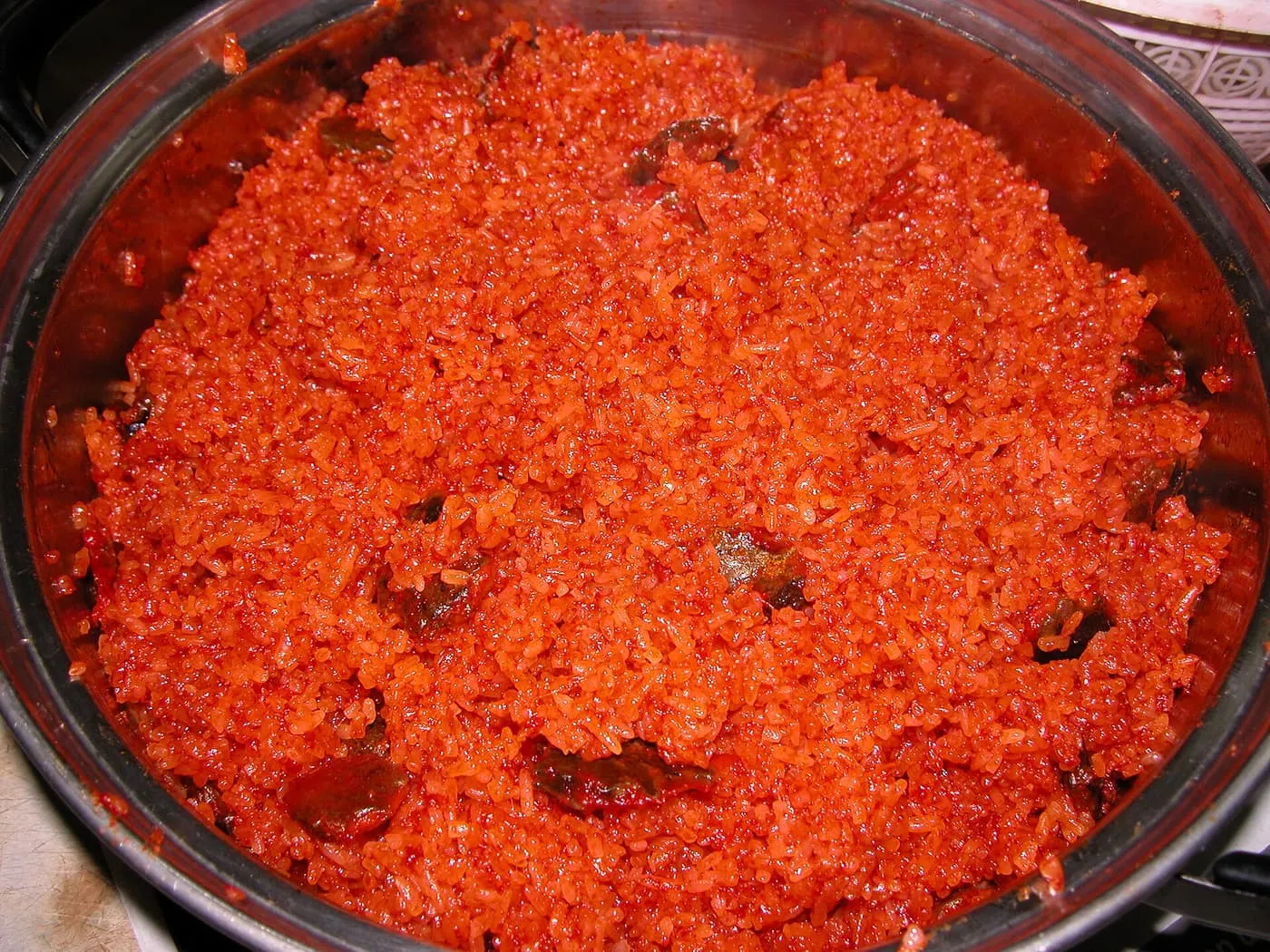
Xôi gấc, sticky rice colored red with gac fruit, is a traditional Tet dish.
Tết follows a lunisolar calendar, which tracks both the Earth’s movement around the Sun and the Moon’s movement around the Earth. The first day usually falls between late January and 20 February in the Gregorian calendar. Celebrations run from the first day of the first lunar month until at least the third day.
Tết is generally celebrated on the same day as Chinese New Year, also called the Spring Festival. However, there is a one-hour time difference between Vietnam and China, which can place the new moon on different days. The dates occasionally differ as a result. In 1985, for example, Vietnam celebrated Lunar New Year a month before China.
According to the researcher Toan Anh, Tết begins at midnight with the Trừ tịch ceremony. It usually takes place between the hour of the Pig on the 30th day of the 12th lunar month (or the 29th, in a short month) and the hour of the Rat on the first day of the new year.
The researcher Phan Cẩm Thượng notes that the Vietnamese use an agricultural, or lunar, calendar that also accounts for the 24 solar terms, including the equinoxes and solstices. Tết therefore marks not only a new year but also the start of a new farming cycle.
Where Tết came from
The historical account
Most sources say the Lunar New Year holiday was brought to Vietnam by the Chinese. China conquered Vietnam into the Han Dynasty empire in 111 BC and ruled it for most of the following thousand years, until the collapse of the Tang Dynasty in the 10th century. That long period shaped Vietnamese culture, language and administration.
Vietnamese Tết still follows the lunar calendar and keeps original Chinese customs such as lucky money in red envelopes. But Vietnam also developed its own traditions, including its own holiday dishes. Even the zodiac is different: the Vietnamese version has the Buffalo, Cat and Goat in place of the Ox, Rabbit and Sheep.
Other views
The origins of Tết have been debated for generations. The historian Trần Văn Giáp dated Tết Nguyên Đán in Vietnam to the first century AD, a period when northern Vietnam was under Han administration. The legend of bánh chưng and bánh giầy (two rice cakes) suggests the Vietnamese celebrated Tết before the time of the Hùng kings, more than a thousand years before Chinese rule. No substantial archaeological evidence has yet been found to support that claim.
The legend of the Kitchen Gods
One story told about the celebration, recorded by Dat Le Que Thoi, concerns a poor couple forced to separate. The wife later married a wealthy man. One day, while she was burning paper offerings in the courtyard, her former husband came begging for food, and she gave him rice and money. When her new husband found out, she threw herself into the fire. The first husband leapt in after her, and the grieving second husband followed. Moved by their devotion, the Jade Emperor made all three the Kitchen Gods.
How the Tết celebration in Vietnam unfolds
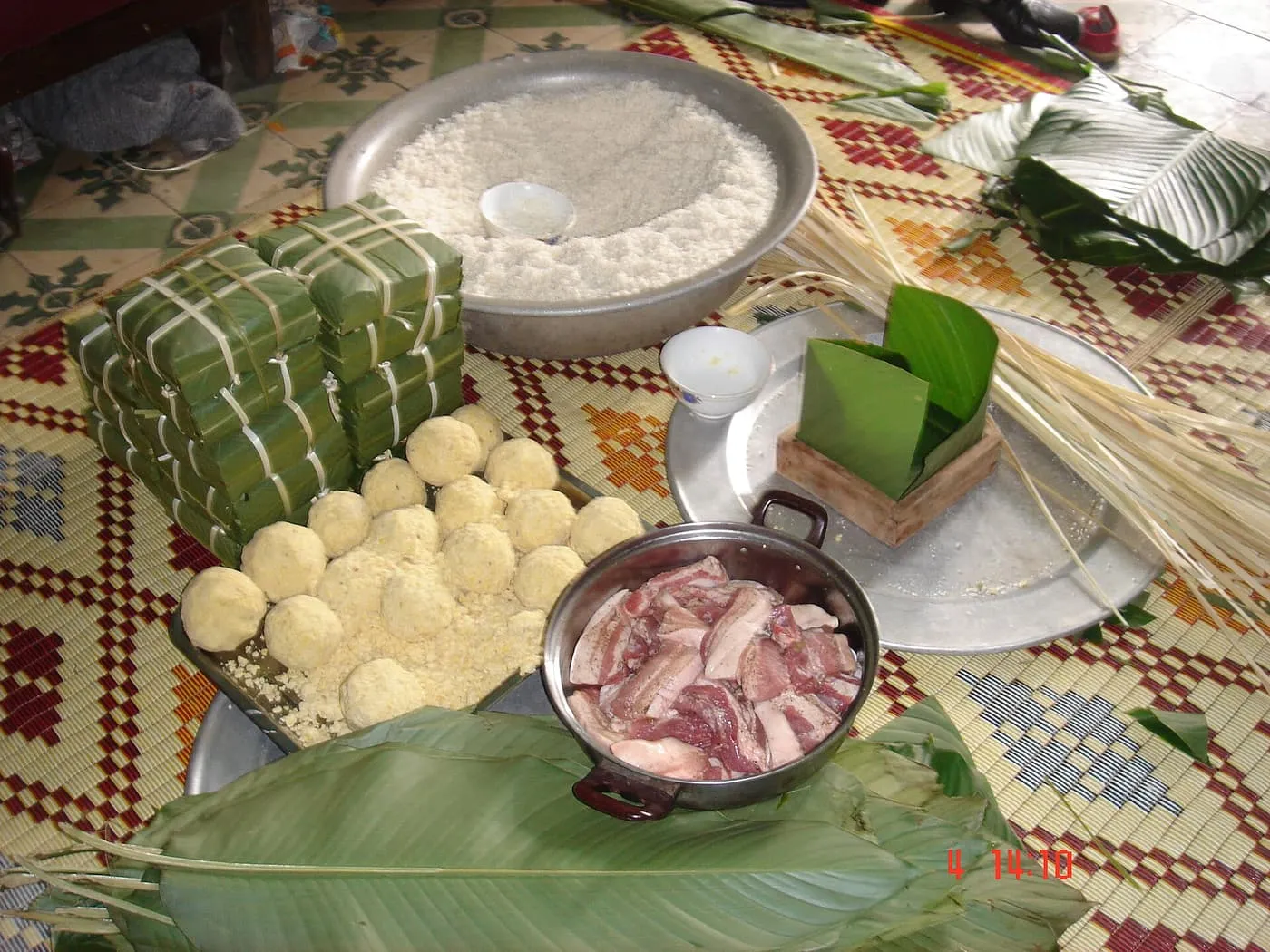
The ingredients for bánh chưng, the square rice cake, are prepared before wrapping.
Tết is usually divided into two parts: about two weeks of preparation before New Year’s Day, and the first three days of the new year, which are given to welcoming and celebrating it. It can also be described in three stages:
- Tất niên – the celebrations before the end of the year
- Giao thừa – New Year’s Eve
- Năm mới – the New Year itself and the days that follow
Although Tết is a national holiday, each region and religion keeps its own customs.
Preparing for the new year
People return home to their families. From the 23rd day of the last lunar month until New Year’s Eve, many families visit their ancestral homeland to worship at the family altar or pay respects at their ancestors’ graves, cleaning and tending the graves as they go.
Houses are cleaned thoroughly before the new year, because sweeping during Tết itself is considered xui or rủi, unlucky. It symbolises sweeping the luck away. Some families also make a point of paying off debts before the new year begins.
The first visitor
One of the most important customs is xông đất, also called xông nhà or đạp đất: being the first person to enter a house in the new year. Vietnamese people believe the first visitor determines the family’s fortune for the whole year. For that reason, nobody enters a house on the first day without being invited. A person of good temper, good morals and success is usually chosen.
Many families take no chances. The head of the house steps outside a few minutes before midnight and walks back in as the clock strikes twelve, so that no one else can be first through the door.
The first three days
The first day of Tết is kept for immediate family. Children put on new clothes, offer their elders traditional New Year greetings, and receive red envelopes of money in return. In the north this is called mừng tuổi (‘happy age’); in the south it is lì xì. Lucky money is also given to elderly people. Red clothing is common because it is associated with good luck.
Keeping harmony in the household matters during these days. Arguments, anger or hatred are thought to bring bad luck for the year ahead. It is also taboo for anyone who has recently lost a family member to visit others during Tết.
Traditionally, though not strictly, the second day is for visiting friends and the third for visiting teachers, who are highly respected in Vietnam. Students usually get a week-long school break.
Local Buddhist temples are popular, as people go to make donations and have their fortunes told. Children spend their new money on toys or on street games such as bầu cua cá cọp.
Noise, lion dances and feasting
Celebrations can last from a single day to a whole week. Streets fill with people making as much noise as they can with firecrackers, drums, bells and gongs to drive away evil spirits. Parades include masks and múa lân, the lion dance. The lân is a creature somewhere between a lion and a dragon, and in Vietnamese culture it symbolises the strength used to scare off evil spirits. Prosperous families may hire dragon dancers to perform at their homes, and there are public performances for everyone.
After the parade, family and friends gather for a feast of traditional dishes.
Decorations and Tết blossoms
Traditionally, each family put up a cây nêu, an artificial New Year tree made from a bamboo pole 5 to 6 metres long. Its top is decorated according to local custom with good luck charms, origami fish, cactus branches and more.
Flowers set the colour of Tết, and they change by region:
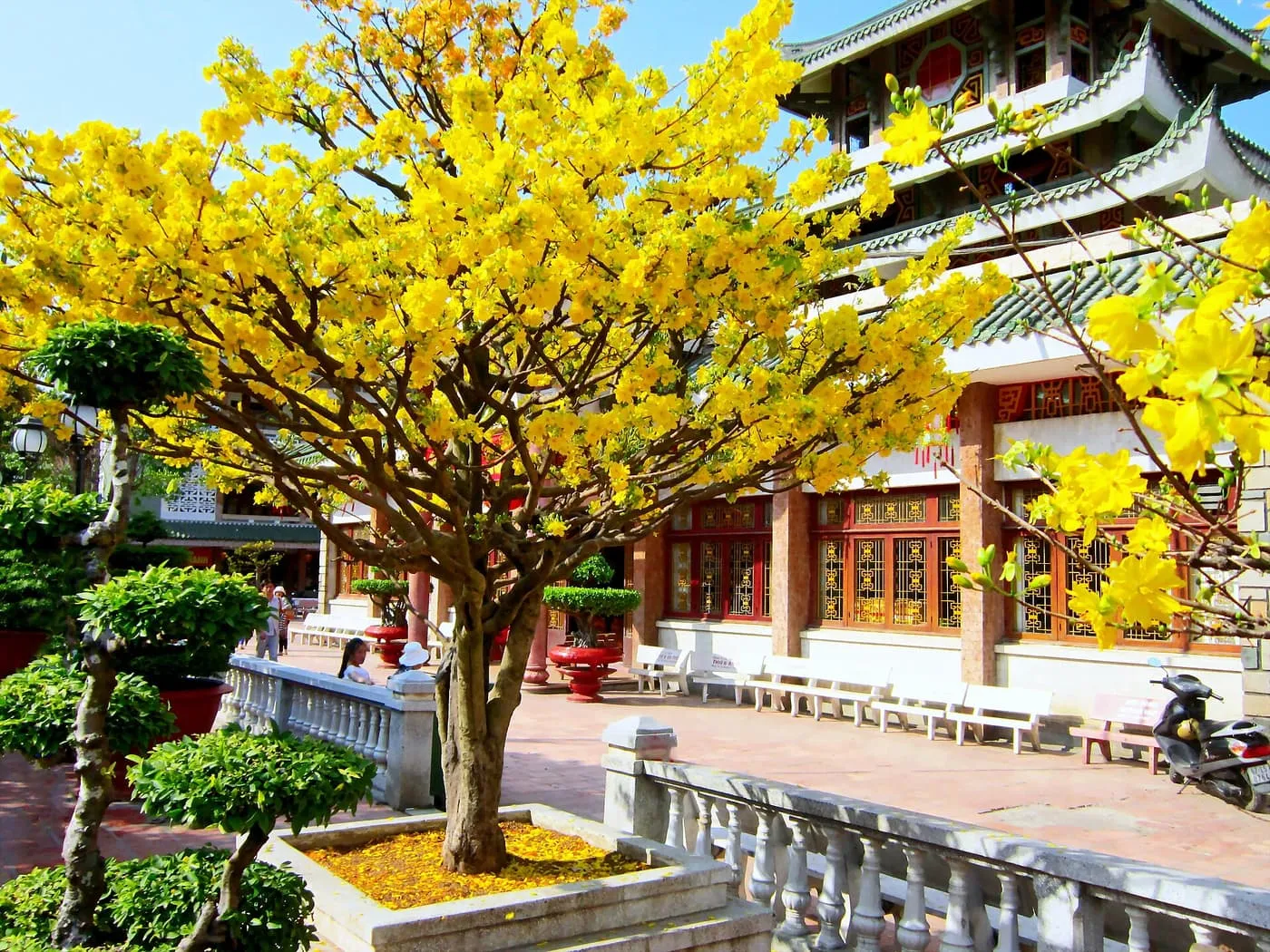
- Central and southern Vietnam: yellow Ochna blossoms, hoa mai
- Northern Vietnam: peach blossoms, hoa đào, and among some (especially the elite in the past) plum blossoms
- Northwestern mountains: mountain ebony, hoa ban
In the north and centre, a kumquat tree is a common living-room decoration; its many fruits stand for the fertility and abundance a family hopes for. Homes also display hòn non bộ (miniature landscapes), chrysanthemums (hoa cúc), marigolds (vạn thọ) for longevity, cockscombs (mào gà) in the south, and paperwhites (thủy tiên) and orchids (hoa lan) in the north. People once tried to time their paperwhites to bloom exactly on the day. Walls are hung with Đông Hồ folk paintings and calligraphy (thư pháp).
The story of the yellow mai
The yellow mai, Ochna integerrima, is especially loved in southern Vietnam, where plants, often shaped bonsai-style, are bought for Tết. A folk tale tells of a brave girl who died after fighting a monster to protect her village. The gods were moved and let her return home for nine days every New Year. When her parents died, she became a flowering tree whose blossoms open each New Year as bright as the yellow shirt she used to wear. People believe the mai can keep ghosts away all year.
Food: eating Tết
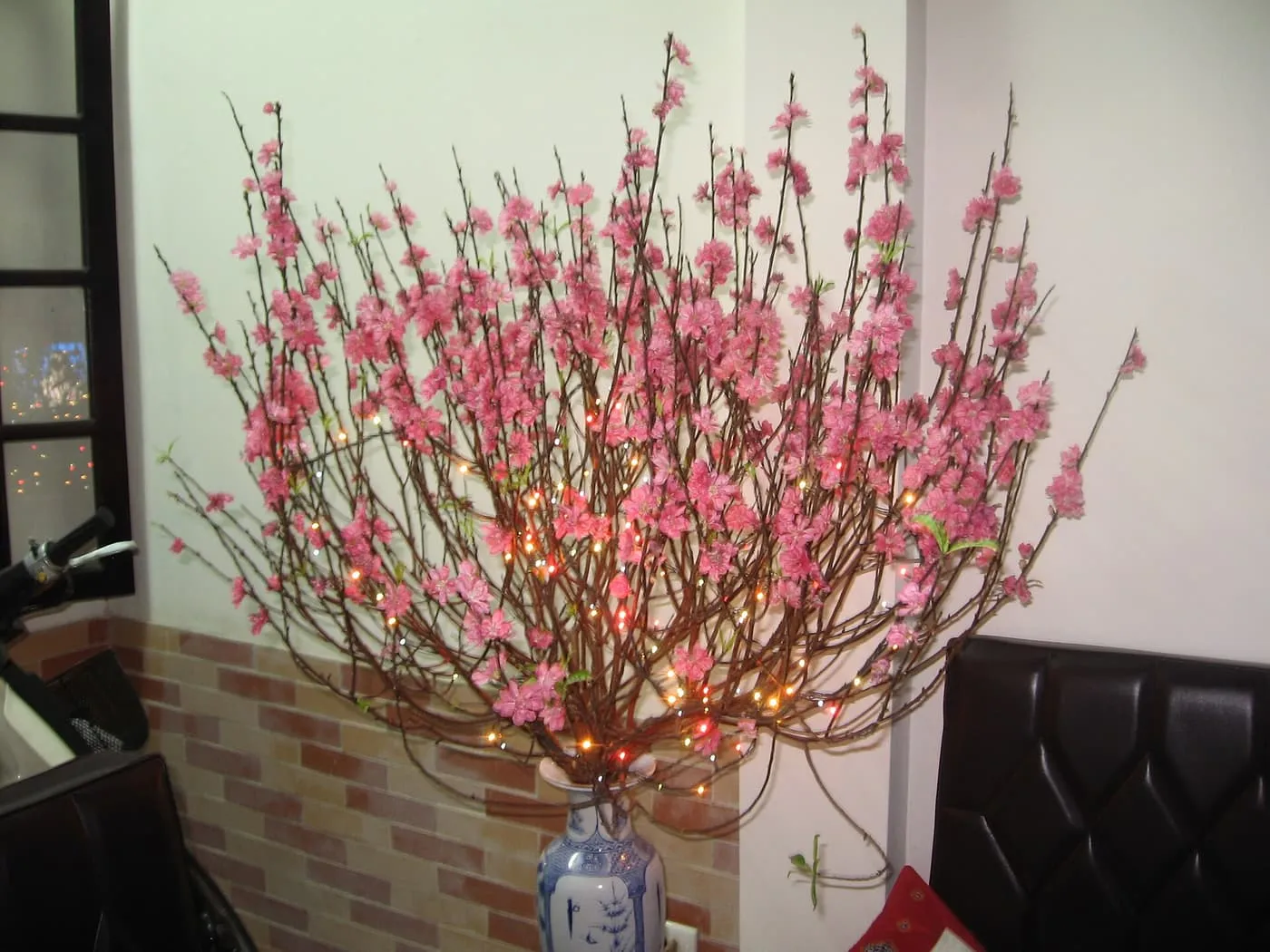
Blooming peach branches decorate homes in Hanoi to welcome the new year.
In Vietnamese, to celebrate Tết is ăn Tết, literally ‘to eat Tết’, which shows how central food is. Some dishes are eaten year-round, others only at Tết, and some are vegetarian because that is believed to bring good luck.
Traditional Tết foods include bánh tét, bánh chưng, bánh dày, canh khổ qua (bitter melon soup), thịt kho hột vịt (pork braised with duck eggs), canh măng (dried young bamboo soup), giò and xôi (sticky rice).
Bánh tét and bánh chưng
Bánh tét is a glutinous rice cake rolled in banana leaf into a thick log, filled with mung bean and pork belly, and boiled for at least six hours. The leaf is removed and the cake sliced into wheels; the ‘tét’ in its name means ‘sliced’ or ‘split’. It can be eaten with pickled scallions, or fried.
Bánh tét is most popular in central and southern Vietnam. In the north, the similar but rectangular cake is bánh chưng. Varieties include bánh tét chuối with banana and sweet red bean, popular in the southwest; bánh tét bắp with corn in the southeast; and a vegetarian version without pork.
Pre-made cakes are sold in nearly every Vietnamese shop, but many families still make their own. The long process is the point: it brings relatives together.
Tết greetings worth knowing
The standard greetings are Chúc mừng năm mới (Happy New Year) and Cung chúc tân xuân (gracious wishes for the new spring). Others include:
- An khang thịnh vượng – security, good health and prosperity
- Vạn sự như ý – may things go your way
- Sức khỏe dồi dào – plenty of health
- Sống lâu trăm tuổi – live to a hundred, said by children to elders
- Chúc hay ăn chóng lớn – eat well, grow quickly, said to children
Buddhists may say Mừng xuân an lạc (happy, peaceful, joyful spring), and Catholics Chúc mừng Chúa Xuân (praise the Lord of Spring). Traditionally everyone turns a year older at Tết, which is why wishes for long life are so common.
Experiencing Tết as a visitor
If you are in Vietnam over the holiday, remember that the first day belongs to the family, and that being first through someone’s door carries real weight, so wait for an invitation. Public lion dances, temple visits and flower displays are the open, shared side of the festival. A simple Chúc mừng năm mới goes a long way.
Frequently asked questions
When is Tết in Vietnam?
Tết falls on the first day of the first month of the Vietnamese lunisolar calendar, usually between late January and 20 February. Celebrations last until at least the third day of the new year.
Is Tết the same as Chinese New Year?
Tết is generally celebrated on the same day as Chinese New Year, but a one-hour time difference between Vietnam and China means the dates occasionally differ, as in 1985. Vietnam also has its own dishes and a different zodiac, with the Buffalo, Cat and Goat.
What is lì xì?
Lì xì is the southern name for lucky money given in red envelopes during Tết; in the north it is called mừng tuổi. Children offer New Year greetings to their elders and receive the envelopes in return.
What food is eaten during Tết?
Traditional dishes include bánh chưng, bánh tét, bánh dày, bitter melon soup, pork braised with duck eggs, dried bamboo shoot soup, giò and sticky rice. Celebrating Tết is called ăn Tết, literally ‘eat Tết’.
Why don’t Vietnamese people sweep during Tết?
Sweeping during Tết is considered unlucky because it symbolises sweeping good luck out of the house. That is why homes are cleaned before the new year begins.
Sources
- Tết, Wikipedia (CC BY-SA 4.0)
- Bánh tét, Wikipedia (CC BY-SA 4.0)
- Ochna integerrima, Wikipedia (CC BY-SA 4.0)
Photos:
- Bùi Thụy Đào Nguyên, CC BY-SA 3.0, via Wikimedia Commons
- Nguyễn Thanh Quang, Public domain, via Wikimedia Commons
- vi:user:Viethavvh, Public domain, via Wikimedia Commons
- Vinataba, CC BY-SA 3.0, via Wikimedia Commons


