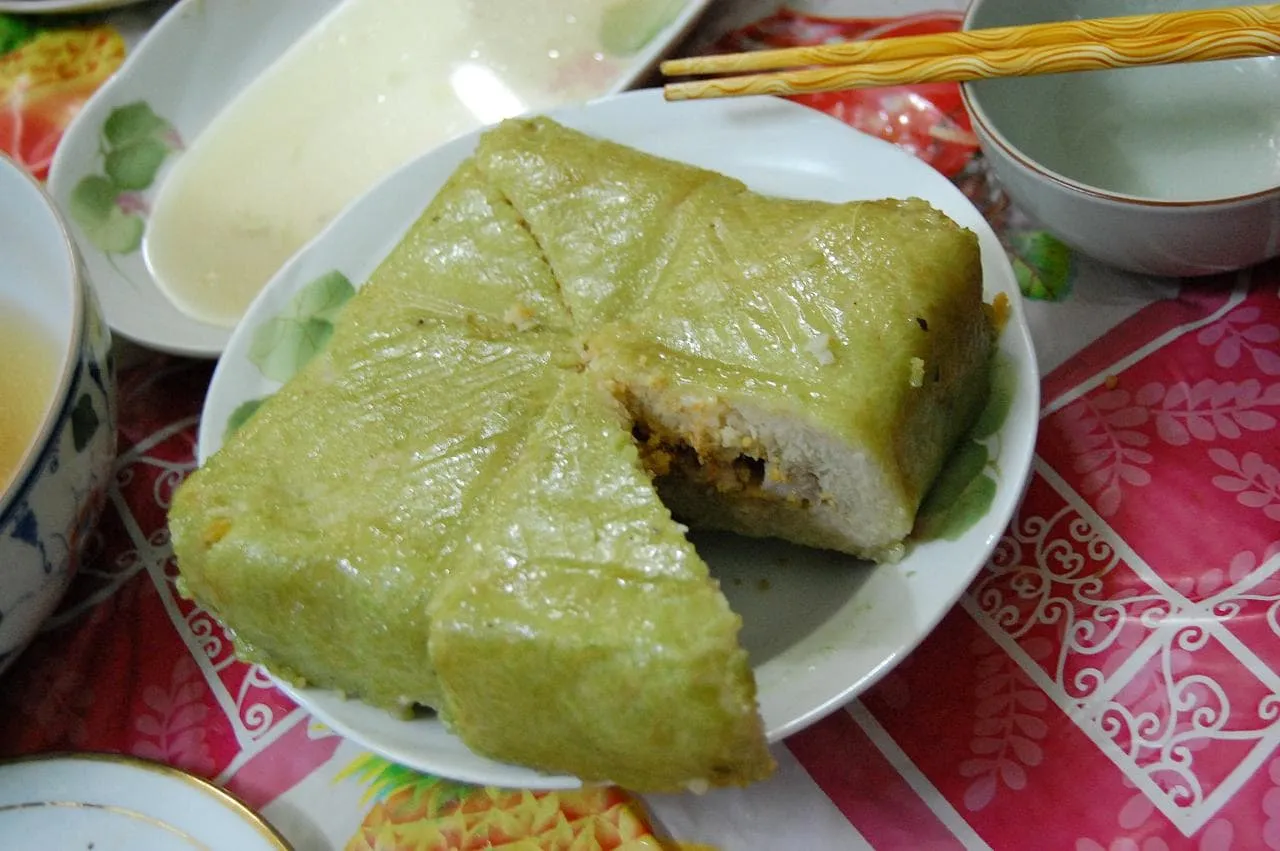
Every Tết, the Vietnamese Lunar New Year, square green parcels appear on family altars across Vietnam. This is banh chung, written bánh chưng in Vietnamese and sometimes called chung cake in English. It is a dense cake of glutinous rice, mung beans and pork, wrapped in leaves and boiled for hours. It carries a legend about a poor prince, a symbol of the earth itself, and the memory of long nights when families sat around a boiling pot waiting for the cakes to be ready.
Bánh chưng is closely tied to Tết, but it is also eaten year-round as a staple of Vietnamese cuisine. Below you will find where it comes from, what goes into it, how it is made, and how it compares with bánh tét, its round, log-shaped cousin from central and southern Vietnam.
The legend of Lang Liêu
The story of bánh chưng is recorded in Lĩnh Nam chích quái (Extraordinary Stories of Lĩnh Nam), a book published in the 14th century. It credits the cake to Lang Liêu, a prince in the last king’s line of the Sixth Hùng Dynasty (c. 1712–1632 BC).
According to the tale, the Hùng king had to choose a successor from among his sons. He set a competition: each prince would bring a delicacy for the ancestral altar at Tết, and whoever offered the most delicious dish would become the next ruler.
The other princes searched the forests and the sea for rare and luxurious foods. Lang Liêu, the eighteenth prince and the poorest of the king’s sons, could not afford anything of the kind. He worked with everyday ingredients such as rice and pork, and from them he made two cakes: a square one called bánh chưng and a round one called bánh giầy.
The king tasted both and found them not only delicious but a fine expression of respect for the ancestors. He gave the throne to Lang Liêu, who went on to found the Seventh Hùng Dynasty (c. 1631–1432 BC). From then on, bánh chưng and bánh giầy became traditional foods of Tết.
Earth and sky: why the cake is square
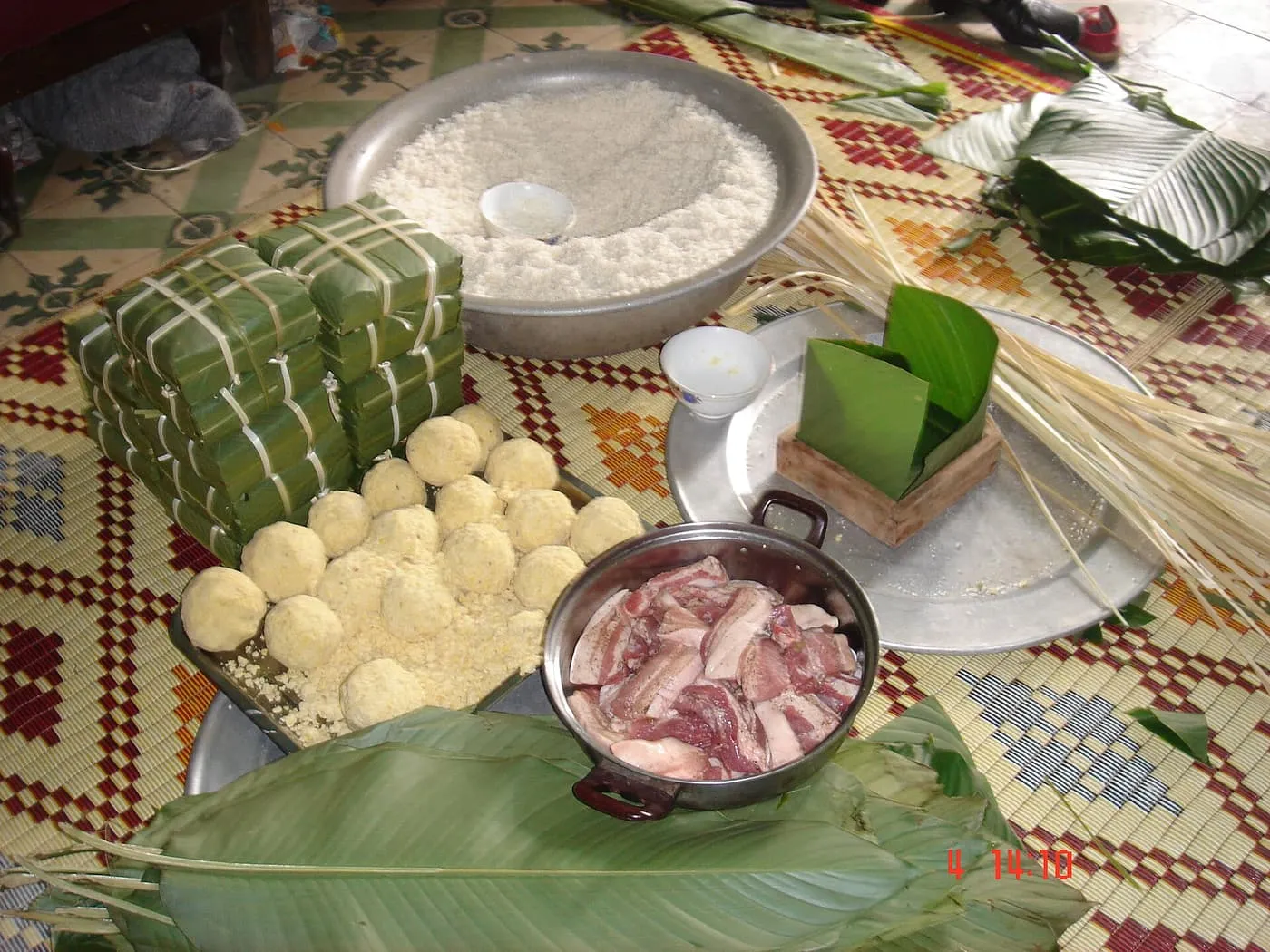
The main ingredients for bánh chưng include glutinous rice, mung beans, pork, and banana leaves.
In the legend, the two cakes stand for the two halves of the world. Bánh chưng, square and wrapped in green, represents the earth. Bánh giầy, round, represents the sky.
The ingredients add to the meaning. They come from the ordinary products of nature – rice, beans, pork, leaves – which is part of why the cake matters so much to Vietnamese people. At Tết, bánh chưng is placed on the family altar to honour the ancestors and to ask for their support in the new year.
What goes into bánh chưng
The filling
The required ingredients are glutinous rice, mung beans, fatty pork, black pepper and salt. Some cooks also add green onion and nước mắm (fish sauce) for a salty taste, and sugar can go into the seasoning as well.
People tend to choose high-quality rice and beans. The mung beans are soaked in water for about 2 hours, then drained, cooked and mashed into a paste. The glutinous rice soaks much longer, for 12 to 14 hours.
Fatty pork is preferred because its richness goes well with the rice and mung beans. The pork is sliced into strips about half an inch thick and mixed with pepper, onion, salt and nước mắm.
The wrapping
The cake is wrapped in lá dong, a leaf found mainly in Southern Asia. Where it is not available, banana leaves or even lá bàng can be used instead. The parcel is tied with strings split from giang, a type of bamboo with long nodes. Many makers also use a square wooden mould to get a neater shape.
The leaves and giang strings must be washed carefully so they do not spoil the taste of the cake. The strings may be soaked or steamed to make them flexible enough for wrapping and tying.
How the cake is assembled
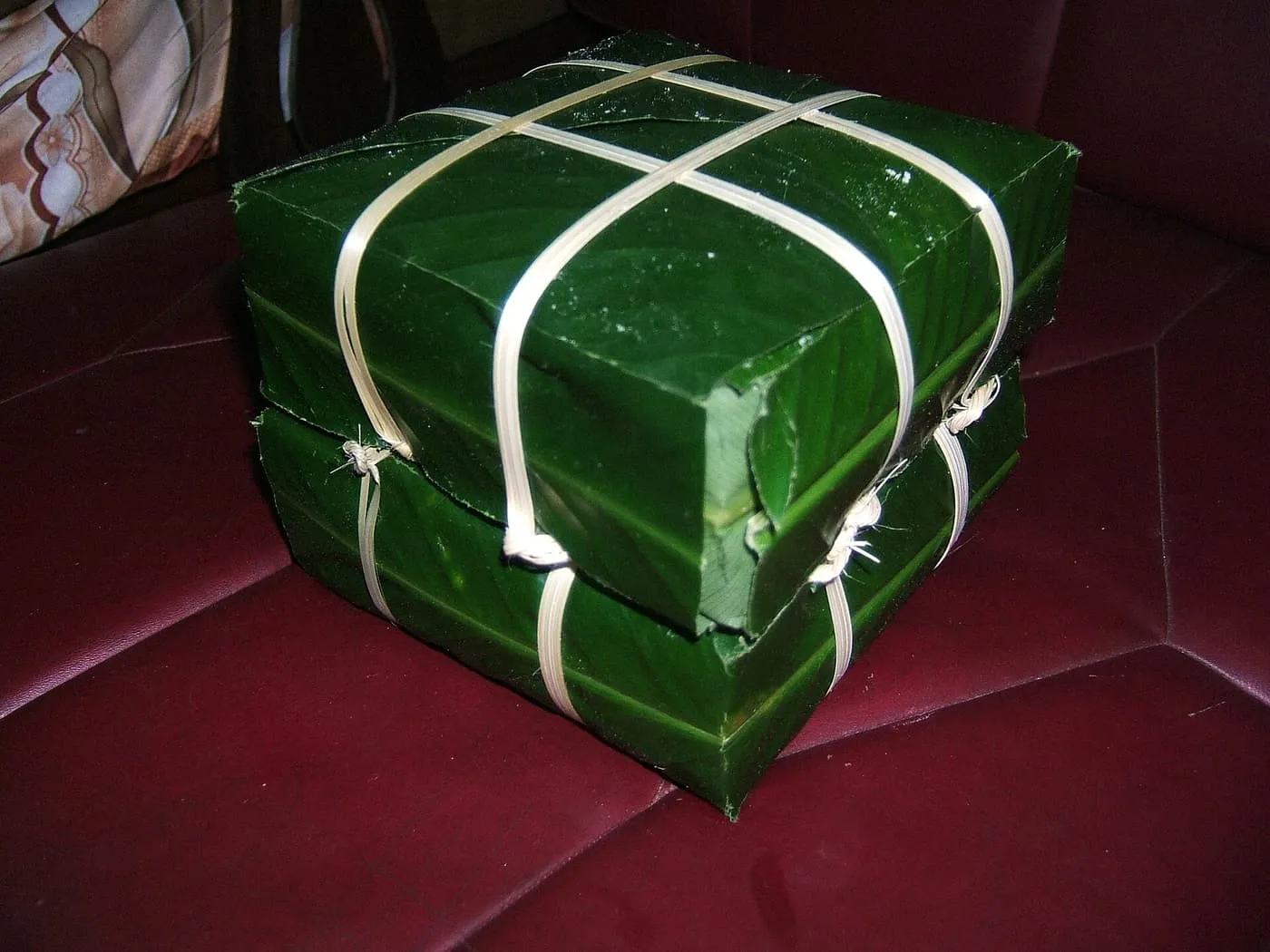
Bánh chưng are usually made in square pairs, wrapped in leaves and tied tightly with strips.
Wrapping follows a set order:
- Giang strings and two lá dong leaves are laid down as the square base.
- A layer of glutinous rice goes onto the leaves.
- Then mung bean, then pork, then more mung bean.
- A final layer of rice goes on top, so that the bean and pork sit in the centre.
The ingredients are folded into the lá dong and bound tightly with giang strings into a square. With a mould, the maker presses the filling into the corners for a near-perfect shape. The cake should be wrapped as tightly as possible, since that helps keep it from going mouldy or spoiling.
Ten to twelve hours by the pot
The finished cakes are arranged in a large pot, with chopsticks, bamboo or other spacers keeping them apart. The pot is filled with fresh water and boiled until the cakes are cooked through. Traditionally this takes ten to twelve hours.
As the water evaporates, more boiled water is added so the cakes stay submerged the whole time. During cooking, the outer layer of rice absorbs colour from the lá dong and turns green. That is the “green bánh chưng” of Tết poetry.
Cutting and serving
A bánh chưng is usually cut into eight triangular pieces or nine square ones, often using the same giang string that tied the cake. Because it is built in layers, each bite tastes a little different: the rice, the pork, the bean and even the leaf all come through in different measure.
Bánh chưng is normally eaten warm or at room temperature. It is often served with pickled onions or vegetables, chả lụa (Vietnamese pork roll) and nước mắm.
A Tết tradition built around the family
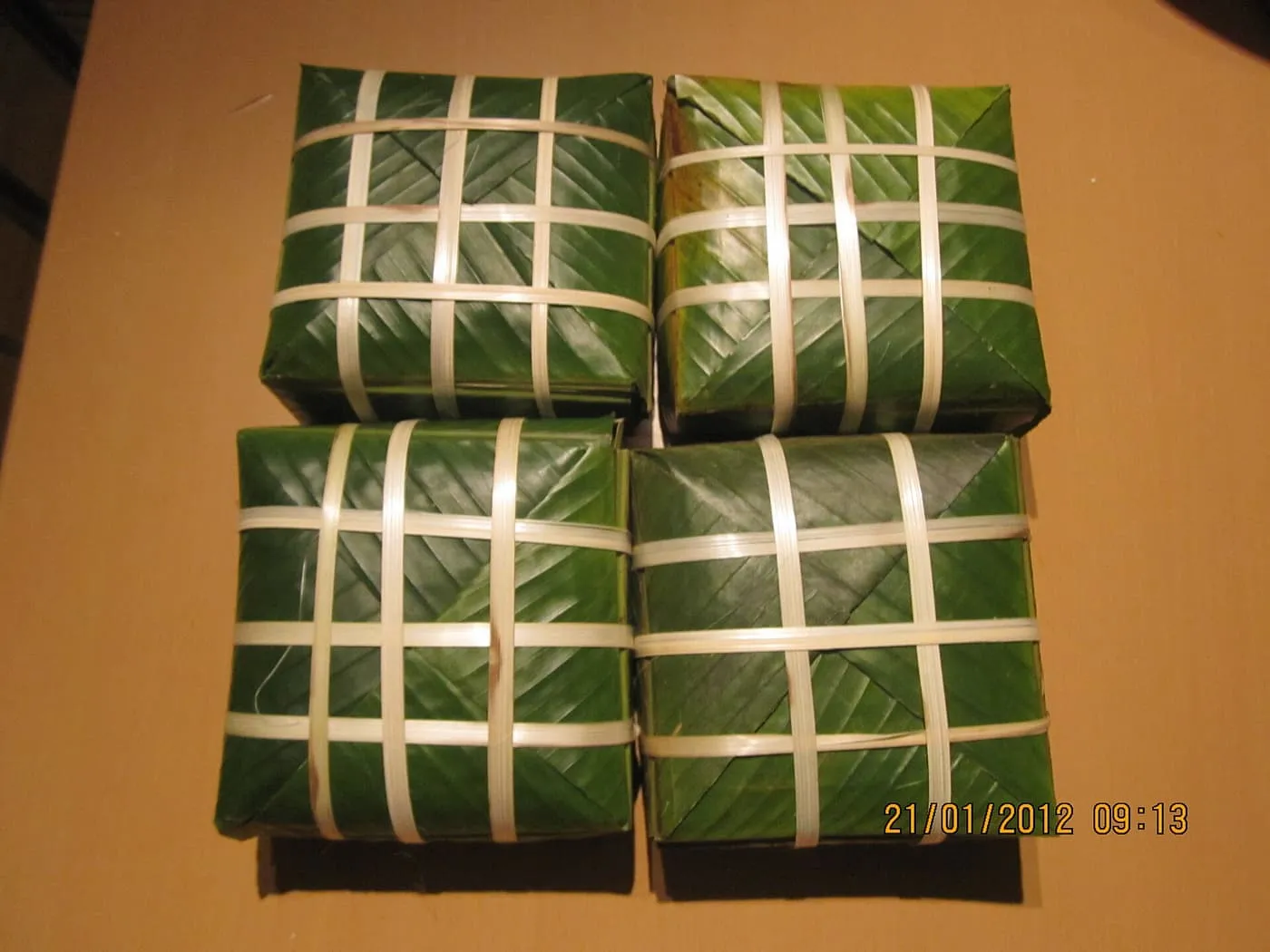
Wrapped bánh chưng are tied with strips of leaf before being boiled for many hours.
A well-known couplet lists the things that make a traditional Tết:
Thịt mỡ, dưa hành, câu đối đỏ Cây nêu, tràng pháo, bánh chưng xanh
Rich meats, pickled onions, red couplets Nêu tree, firecrackers, green bánh chưng
Because the cake needs so many ingredients, families that can afford it traditionally begin making bánh chưng on the 27th or 28th day of tháng Chạp, the twelfth month of the Vietnamese calendar. Everyone has a job: washing the lá dong, seasoning the pork, preparing the mung beans, and most importantly wrapping the cakes and boiling them. Through the long hours of cooking, adults and children sit together around the cauldron.
In the countryside, villagers made sure even poor families would have bánh chưng for Tết. They set up a shared fund called họ bánh chưng. About a month before Tết, the money collected and its earnings were divided among the members so each household could afford to make its cakes.
From family kitchens to craft villages
Homemade bánh chưng is becoming less common in Vietnam. Families are smaller, and many people no longer have time for the preparation. Instead, they buy from bánh chưng shops or order in advance from families who specialise in making them. The cake still sits on every Tết table, but it is often no longer made at home.
As production has moved to specialist makers, some craft villages have built a name for their bánh chưng. Two of the best known are Tranh Khúc village and Duyên Hà village, both in Thanh Trì, Hanoi.
The bánh chưng competition at Hùng Temple
The link between bánh chưng and the Hùng kings is still celebrated. Each year, on the death anniversary of the Hùng Kings, a bánh chưng and bánh dày (another name for bánh giầy) making competition is often held at Hùng Temple in Phú Thọ.
Teams from eight regions, including Lào Cai, Hanoi and Cần Thơ, receive 5 kg of glutinous rice, beans and 1 kg of pork. Their task is to make 10 bánh chưng in 10 minutes. The winning team’s cakes are presented on the official altar of the festival.
In 2005, bánh chưng makers in Ho Chi Minh City offered Hùng Temple a pair of giant cakes. The bánh chưng measured 1.8 m x 1.8 m x 0.7 m (71 x 71 x 27.5 inches) and weighed 2 tonnes after cooking. It was made in Ho Chi Minh City and then transported to Phú Thọ.
Variations on bánh chưng
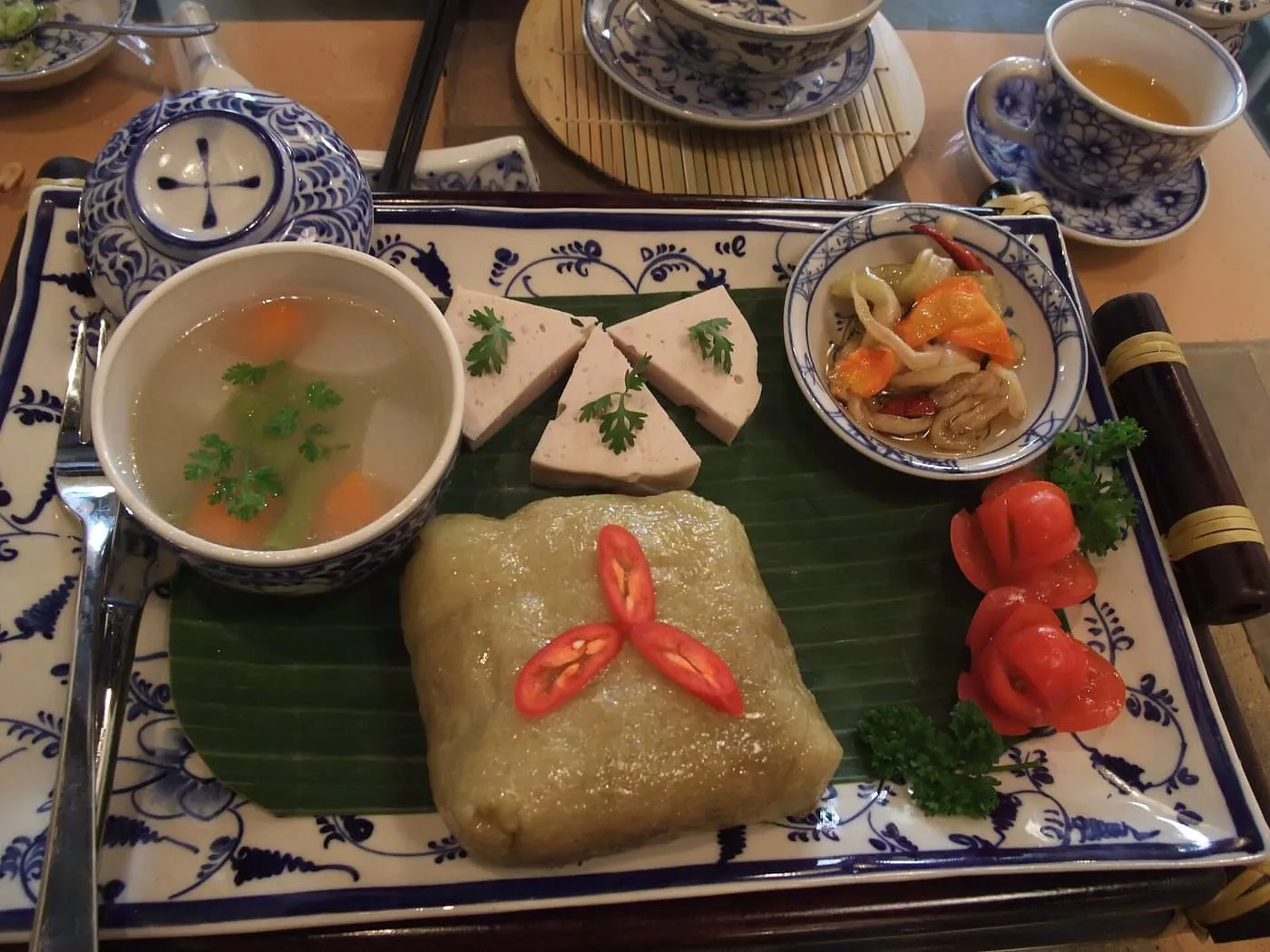
Bánh chưng is often served as part of a meal alongside pork roll, tofu, and pickles.
Bánh chưng rán
Leftover bánh chưng can be fried into a crisp pancake, called bánh chưng rán or bánh chưng chiên (fried bánh chưng). The writer Vũ Bằng, in his book Thương nhớ mười hai (Longing of the 12 Months), describes bánh chưng rán as a delicious dish of Hanoi’s cold winter.
Bánh tày and long bánh chưng
Some places in the north make a cylindrical cake similar to bánh tét, known as bánh tày, bánh chưng dài (long bánh chưng) or bánh dài. Bánh tày usually has only a little mung bean and little or no pork, so it keeps longer. Like bánh chưng, it can be sliced and fried.
Bánh chưng gù
The San Diu people make a long bánh chưng with a hump in the middle, called bánh chưng “gù” (“humped” bánh chưng). Besides lá dong, it is wrapped in an extra leaf called lá chít.
Vegetarian and sweet versions
For vegetarians and Buddhists there are bánh chưng chay (vegetarian chung cake) and bánh chưng ngọt (sweetened chung cake). These are filled with molasses or brown sugar instead of pork. Sometimes the rice is mixed with gac, which gives the cake a red skin many people find more appetising.
In the countryside, bánh chưng chay was once made by poor families who could not afford pork. They filled the cake with cardamom, black pepper and cooked mung bean, and ate it with molasses.
Banh chung and banh tet: how they differ
Search for one and you will soon meet the other. Bánh tét is made from almost the same ingredients: glutinous rice, mung bean and pork. The main differences are shape, region and wrapping.
- Shape: Bánh chưng is square. Bánh tét is rolled into a thick, log-like cylinder.
- Region: Bánh tét is traditional to, and most popular in, central and southern Vietnam. In the north, the equivalent rectangular cake is bánh chưng.
- Wrapping: Bánh tét is rolled in banana leaves and tied tightly with string. It is often wrapped again with plastic ribbon or rope so the leaves do not come apart in the pot.
- Cooking: Bánh tét boils for at least six hours. Bánh chưng traditionally takes ten to twelve.
- Serving: Once cooked, bánh tét is unwrapped and cut into wheel-shaped slices. The name reflects this: “tét” means “sliced” or “split”. It is often eaten with pickled scallions and, like bánh chưng, can be fried.
Bánh tét has its own regional versions. In the southwest, the best known is bánh tét chuối, filled with banana and sweet red bean. In the southeast, it is bánh tét bắp, made with corn. There is also a vegetarian bánh tét with no pork.
Both cakes play the same role at Tết. They bring families together to make them, and they show the central place of rice in Vietnamese culture.
Keeping bánh chưng after Tết
Bánh chưng is usually made in batches, so leftovers are normal. An unopened cake keeps for up to two weeks in the refrigerator. Once unwrapped, it stays good for several days in the fridge. It can also be frozen and thawed, though the texture is not as good as a fresh cake. And when the slices start to firm up, there is always bánh chưng rán.
Frequently asked questions
What is banh chung?
Bánh chưng, or chung cake, is a traditional Vietnamese cake of glutinous rice, mung beans and fatty pork, wrapped in lá dong leaves and boiled. It is an essential offering on the family altar at Tết, but it is also eaten year-round.
What is the difference between banh chung and banh tet?
They share almost the same ingredients, but bánh chưng is square and associated with the north, while bánh tét is a log-shaped cylinder rolled in banana leaves. Bánh tét is most popular in central and southern Vietnam and is served in wheel-shaped slices.
Why is banh chung square?
According to the legend of Prince Lang Liêu, the square bánh chưng represents the earth, while the round bánh giầy represents the sky.
How long does banh chung take to cook?
Traditionally, bánh chưng is boiled for ten to twelve hours. Boiled water is added as the water evaporates so the cakes stay submerged.
How long does banh chung keep?
An unopened bánh chưng can be kept for up to two weeks in the refrigerator, and an unwrapped one stays edible for several days in the fridge. It can also be frozen, though the quality is not as good as fresh.
Sources
- Bánh chưng, Wikipedia (CC BY-SA 4.0)
- Bánh tét, Wikipedia (CC BY-SA 4.0)
Photos:
- pmquan, CC BY 2.0, via Wikimedia Commons
- vi:user:Viethavvh, Public domain, via Wikimedia Commons
- Viethavvh at vi.wikipedia, Public domain, via Wikimedia Commons
- TRMC, CC BY-SA 3.0, via Wikimedia Commons
- Yun Huang Yong, CC BY 2.0, via Wikimedia Commons


